
RNasin®: The Most Trusted Name in RNase Inhibition
Protect your RNA from degradation with Promegas RNasin® Ribonuclease Inhibitors
RNasin® Ribonuclease Inhibitors are specialized proteins used to protect RNA from degradation, used worldwide in the life science industry. They work by blocking RNases — enzymes that break down RNA — which are commonly found in the environment, on lab surfaces, and even on human skin.
Use RNasin® Ribonuclease Inhibitors for RNA isolation, RT-PCR, in vitro transcription, or any situation where RNase contamination is a concern.
| RNasin Ribonuclease Inhibitor | RNasin Plus Ribonuclease Inhibitor |
|
• Inhibits RNase A, B and C as well as human placental RNase.
|
• Possesses all the proven features of Recombinant RNasin® Ribonuclease Inhibitor.
|
RNase Contamination Happens, Even When You Are Careful
RNases are ubiquitous and can cause RNA degradation and compromise RNA integrity. They are:
- Extremely stable and hard to eliminate
- Found everywhere — on hands, labware, dust, and even in water
- Capable of ruining RNA samples, leading to poor results or failed experiments
Even in clean labs, RNase contamination is common. RNase contamination can happen during RNA purification and during routine downstream handling. RNasin® Ribonuclease Inhibitors inhibit RNase A family and human placental RNases by noncovalently binding to RNases.
When testing nine buffer and water stock solutions from an RNA-free zone of an academic lab for RNases, seven showed varying degrees of RNase contamination. For all samples tested, the RNA remained intact during the overnight incubation at 37 °C when Recombinant RNasin® Ribonuclease Inhibitor was added. Details of this experiment can be found in this technical article.
Not all RNase Inhibitors are Equal...
... Some RNase inhibitors offer less than half the protection of Promega RNasin® Inhibitor.
RNasin® Ribonuclease Inhibitor and RNaseOUT™ was compared for inhibition of RNase A during RT-qPCR. RNA was reverse transcribed and amplified in the presence of RNase A and either Promega RNasin® or RNaseOUT™. RNasin® Inhibitor provided better RNA protection in the presence of RNase, as shown by higher levels of mRNA.
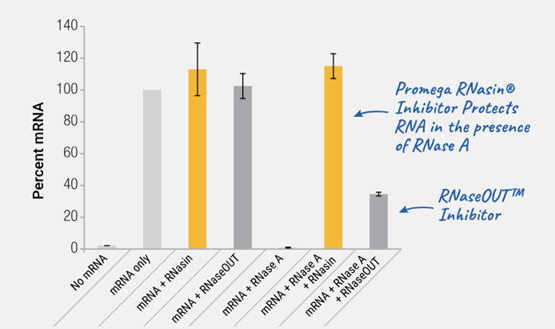
Illustration of the RNA protection with Promega RNasin® versus RNaseOUT™ in the presence of RNase A.
Tips for Maintaining an RNase-Free Environment
Establish an “RNA Only Work Zone” in your lab that has dedicated equipment, reagents, labware, etc. Use these tips to help you avoid RNase contamination:
- Wear gloves and use sterile technique when handling RNA or reagents that will be used with RNA.
- The most common sources of RNase contamination are hands and bacteria or mold that could be lurking on dust particles or on glassware.
- Use sterile, disposable plasticware.
- These products are typically RNase-free and do not require treatment to inactivate RNases.
- Treat non-disposable glassware and plasticware before you use it. For glassware, bake it at 250 °C overnight.
- For plasticware, rinse it with 0.1N NaOH/1mM EDTA and then with diethyl pyrocarbonate (DEPC)-treated water.
- Reserve a set of chemicals and solutions needed for RNA isolation and analysis as “RNA Only” and keep them separate from reagents for other applications.
- Wear gloves whenever you handle these reagents, and use sterile labware to measure them.
- Beware! Autoclaving alone is not sufficient to inactivate all RNases.
- Solutions that you prepare in the lab should be treated by adding DEPC to 0.05% and incubated overnight. Autoclaving the treated solutions for 30 minutes will remove any trace of the DEPC from the solution.
- Use RNasin® Ribonuclease Inhibitor to help prevent RNA degradation.
For any questions or concerns, please contact Charlotte Otéma.
Looking for RNase Inhibitors? Browse through our assortment:
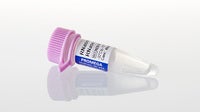
RNasin Ribonuclease Inhibitor
Inhibits RNase A, B and C as well as human placental RNase. Does not inhibit other RNases and modifying enzymes like reverse transcriptases... more
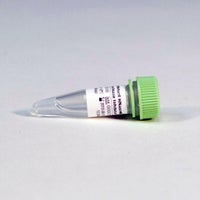
rRNasin Ribonuclease Inhibitor
Recombinant RNasin Inhibits that RNase A, B and C as well as human placental RNase. Does not inhibit other RNases and modifying enzymes like reverse transcriptases... more
RNasin Plus RNase Inhibitor
Possesses all the proven features of Recombinant RNasin® Ribonuclease Inhibitor. Stable against oxidation and heat, leading to higher stability—up to 15 minutes at 70 °C... more