
Pipette Ergonomics – Best Practices for Reducing Strain in the Lab
Pipettes are one of our closest companions in the lab, as they are used for transferring microliter volumes from one vessel to another. This leads to pipetting—the use of pipettes—being a repetitive task that may lead to strain disorders.
There have been several papers over the last two decades that have studied ergonomics in relation to pipetting. With the wrong pipetting technique, you risk causing a lot of strain to your arm and thumb. ¹
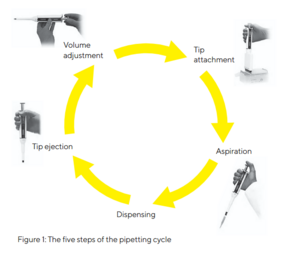
Imagine pipetting as a cycle consisting of five steps:
1. Volume adjustment
2. Tip attachment
3. Aspiration
4. Dispensing
5. Tip ejection
Different muscles are engaged and activated during the various phases of the pipetting cycle, meaning your pipetting technique will vary between steps.
Common ergonomic mistakes during pipetting and how to fix them:
1. The volume changes midway during pipetting causing an interrupted workflow.
Solution? With a volume lock, you can be sure that the volume stays the same. The lock should be easy to use, using either one or two hands.
2. Volume setup is difficult and time-consuming.
Solution? A clear and easy-to-read display ensures that the volume setup is easy and quick. The display should also be visible while pipetting, to be able to check the volume.
3. Using excessive force during tip attachment causing damage to pipettes.
Solution? Tip attachment should be light and easy to avoid causing damage to your pipette or tip, which in turn can cause leaks.
4. An inconveniently placed plunger or operating button causing discomfort and strain to the thumb.
Solution? A conveniently located plunger is comfortable to use and minimizes the need to extend the thumb to extreme positions. Electronic pipettes control the piston movement, but the operating button must be positioned so that it is comfortable to use.
5. A finger hook that causes stress and pressure on the hand.
Solution? A good finger hook minimizes the force required to grip the pipette and allows the pipette to rest in the hand with minimum effort.
6. An uncomfortable handle that causes strain on your arm and thumb.
Solution? The handle shape should support the finger hook to allow the pipette to rest in the hand without squeezing it. A proper handle fits well in the hand and feels comfortable to hold, even while working.
7. The pipette being heavy and causing strain.
Solution? Light pipettes create less strain. The heavier the pipette, the more the strain.
8. The wrist and shoulder are tense or strained while pipetting.
Solution? Choose a pipette that allows you to relax your shoulder and permits a neutral wrist position while pipetting. Also, the pipette & tip combination should be able to reach the bottom of the vessels used.
9. Faulty tip ejection.
Solution? A proper tip ejector system reduces strain on the thumb. It should be easy to reach and minimal force to use. In some electronic pipettes, the tip ejection is electronic, thus requiring less force to use.
Checklist for good pipette ergonomics!
✅ Pipette display should be visible and easy to read
✅ Plunger and other buttons should be easy to press
✅ Tip ejection should work without using force
✅ Pipette handle and finger hook should be designed to allow the pipette to rest in your hand without squeezing it
✅ Designed for left or right handed users
Standing while working:
✅ Bench must adjust to the height of your elbows to relax your shoulders
✅ Your leg room should be free. Lifting your foot on a low platform relaxes your lower back
Seated while working:
✅ Adjust your chair so that your back is in a neutral position, your elbows close to your body, your arms are supported by the bench and your shoulders are relaxed
✅ Your thighs should not be pressed against the front edge of your chair as it weakens blood circulation in your legs and your feet should rest steadily on the floor or footrest
✅ Working tools that are used most should be right in front of you; right handed: tools on the left side, left handed: tools on the right side
✅ Use an elbow pad
✅ Ejection of tip: waste basket should have a low profile
Want to know more about pipette ergonomics or our pipette assortment? Contact Peggy Roth.
For pipette maintenance and calibration services, contact Pipettdoktorn.
¹ Matilla, U. (2017). Pipetting Ergonomics. Sartorius.